


Ancient Era
Classical Era
Medieval Era
Renaissance Era
Casa de Contratación
Forbidden City
Great Zimbabwe
Potala Palace
St. Basil's Cathedral
Taj Mahal
Torre de Belém
Venetian Arsenal
Industrial Era
Modern Era
Atomic Era
Projects


Taj Mahal
Description
+1 Era Score from Historic Moment earned after this wonder is complete if that Moment is usually worth 2 or more Era Score. Must be built next to a River.
Historical Context
Mughal Emperor Shah Jahān had many wives, but Mumtāz Mahal (his third wife) was by far his favorite. After Mahal died in childbirth in 1631, Jahān immortalized his beloved with the grandest mausoleum he could imagine. The Taj Mahal’s construction required 20,000 laborers working for two decades. No mere tomb, the structure also housed a mosque and even a guesthouse—presumably for guests who preferred not to rest in a tomb.
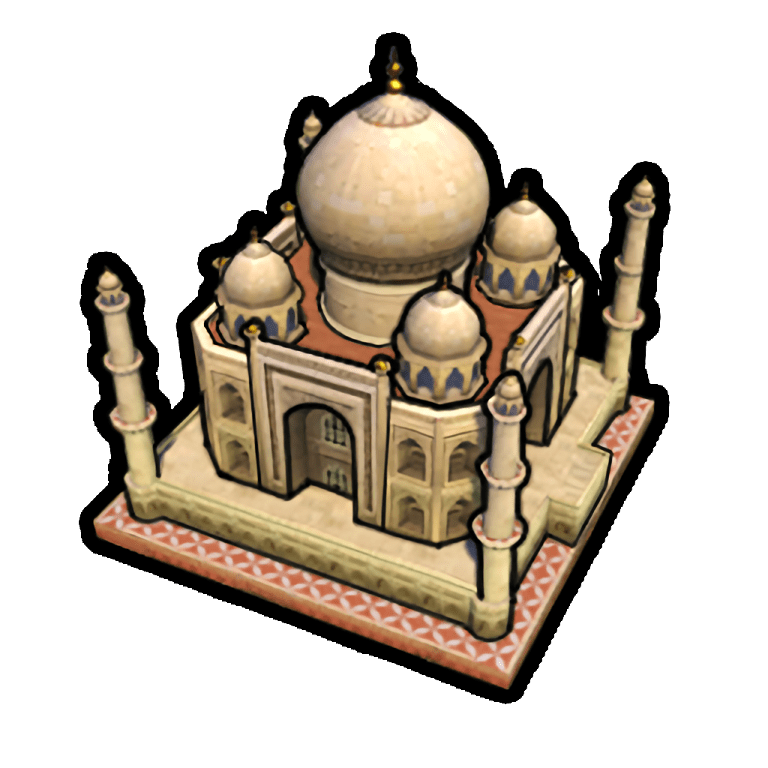
Jahān would not have long to appreciate the labors of 20,000 laborers. A violent succession struggle amongst his sons saw him placed under house arrest shortly after the Taj Mahal’s completion. Until his death in 1666, Jahān need only look out the window to observe his creation: the four tall minarets, the giant domed building seeming to fill the sky—all built with brick-in-lime mortar, red sandstone, and marble. The temple to Jahān’s love for Mahal still stands in India.
Jahān would not have long to appreciate the labors of 20,000 laborers. A violent succession struggle amongst his sons saw him placed under house arrest shortly after the Taj Mahal’s completion. Until his death in 1666, Jahān need only look out the window to observe his creation: the four tall minarets, the giant domed building seeming to fill the sky—all built with brick-in-lime mortar, red sandstone, and marble. The temple to Jahān’s love for Mahal still stands in India.
“Did you ever build a castle in the air? Here is one, brought down to earth and fixed for the wonder of ages.”
– Bayard Taylor
– Bayard Taylor
Traits
Removed if game started after
Information Era
+1000  Tourism from Rock Concerts.
Tourism from Rock Concerts.
 Production
Description
+1 Era Score from Historic Moment earned after this wonder is complete if that Moment is usually worth 2 or more Era Score. Must be built next to a River.
Historical Context
Mughal Emperor Shah Jahān had many wives, but Mumtāz Mahal (his third wife) was by far his favorite. After Mahal died in childbirth in 1631, Jahān immortalized his beloved with the grandest mausoleum he could imagine. The Taj Mahal’s construction required 20,000 laborers working for two decades. No mere tomb, the structure also housed a mosque and even a guesthouse—presumably for guests who preferred not to rest in a tomb.
Jahān would not have long to appreciate the labors of 20,000 laborers. A violent succession struggle amongst his sons saw him placed under house arrest shortly after the Taj Mahal’s completion. Until his death in 1666, Jahān need only look out the window to observe his creation: the four tall minarets, the giant domed building seeming to fill the sky—all built with brick-in-lime mortar, red sandstone, and marble. The temple to Jahān’s love for Mahal still stands in India.
Jahān would not have long to appreciate the labors of 20,000 laborers. A violent succession struggle amongst his sons saw him placed under house arrest shortly after the Taj Mahal’s completion. Until his death in 1666, Jahān need only look out the window to observe his creation: the four tall minarets, the giant domed building seeming to fill the sky—all built with brick-in-lime mortar, red sandstone, and marble. The temple to Jahān’s love for Mahal still stands in India.
“Did you ever build a castle in the air? Here is one, brought down to earth and fixed for the wonder of ages.”
– Bayard Taylor
– Bayard Taylor
Traits
Removed if game started after
Information Era
+1000 Tourism from Rock Concerts.
Tourism from Rock Concerts.