


Governors
Amani (Diplomat)
Hermetic Order Titles
Ibrahim (Grand Vizier)
Liang (Surveyor)
Magnus (Steward)
Moksha (Cardinal)
Owls of Minerva Titles
Pingala (Educator)
Reyna (Financier)
Sanguine Pact Titles
Victor (Castellan)
Voidsingers Titles
Castellan Titles
Redoubt
Defense Logistics
Garrison Commander
Embrasure
Air Defense Initiative
Arms Race Proponent
Financier Titles
Land Acquisition
Forestry Management
Harbormaster
Tax Collector
Contractor
Renewable Subsidizer
Steward Titles
Groundbreaker
Provision
Surplus Logistics
Black Marketeer
Industrialist
Vertical Integration


Voidsingers (Secret Society)
Description
The Voidsingers are a nihilistic cult of dark elder gods. They focus on religion, relics, and (dis)loyalty.
Historical Context
In the early 20th century, a new genre of science fiction and fantasy began to take hold, especially in the United States and UK. The horrors of World War I had proven that a new, scientific age could potentially be an inhuman one, and the universe revealed by exploration and scientific inquiry could be just as profoundly uncaring about humanity and its hopes and dreams. In addition, for citizens in colonizing countries, a growing awareness that the colonized world could in fact return to haunt the colonizers lent itself to a kind of isolationism – something helped along by that era’s virulent racism. The speculative worlds that emerged in the fiction of authors such as Arthur Machen, H.P. Lovecraft, and others were neither the morally-tinged Gothic nor the heroic tales of exploration of the 19th century, but something more disturbing, a new, “weird” fiction.
A weird reality is one where the powers that shape the world are fundamentally uncaring and even hostile to humanity. While their inattention allows us to exist in the world today, traces of them might persist in forgotten places, drowned cities, or in the spaces between the stars, and might be revealed by science’s forward progress. In weird fiction, the world is one where we do not belong, and only the mad would actually seek out the things that make the world work.
A weird reality is one where the powers that shape the world are fundamentally uncaring and even hostile to humanity. While their inattention allows us to exist in the world today, traces of them might persist in forgotten places, drowned cities, or in the spaces between the stars, and might be revealed by science’s forward progress. In weird fiction, the world is one where we do not belong, and only the mad would actually seek out the things that make the world work.
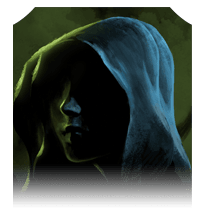
Traits
Titles:
 CanticleChorusMelodySymphony
Description
The Voidsingers are a nihilistic cult of dark elder gods. They focus on religion, relics, and (dis)loyalty.
Historical Context
In the early 20th century, a new genre of science fiction and fantasy began to take hold, especially in the United States and UK. The horrors of World War I had proven that a new, scientific age could potentially be an inhuman one, and the universe revealed by exploration and scientific inquiry could be just as profoundly uncaring about humanity and its hopes and dreams. In addition, for citizens in colonizing countries, a growing awareness that the colonized world could in fact return to haunt the colonizers lent itself to a kind of isolationism – something helped along by that era’s virulent racism. The speculative worlds that emerged in the fiction of authors such as Arthur Machen, H.P. Lovecraft, and others were neither the morally-tinged Gothic nor the heroic tales of exploration of the 19th century, but something more disturbing, a new, “weird” fiction.
A weird reality is one where the powers that shape the world are fundamentally uncaring and even hostile to humanity. While their inattention allows us to exist in the world today, traces of them might persist in forgotten places, drowned cities, or in the spaces between the stars, and might be revealed by science’s forward progress. In weird fiction, the world is one where we do not belong, and only the mad would actually seek out the things that make the world work.
A weird reality is one where the powers that shape the world are fundamentally uncaring and even hostile to humanity. While their inattention allows us to exist in the world today, traces of them might persist in forgotten places, drowned cities, or in the spaces between the stars, and might be revealed by science’s forward progress. In weird fiction, the world is one where we do not belong, and only the mad would actually seek out the things that make the world work.
Traits
Titles:
CanticleChorusMelodySymphony