


Civilizations
Leaders
Introduction
Abraham Lincoln
Alexander
Amanitore
Ambiorix
Basil II
Bà Triệu
Catherine de Medici (Black Queen)
Catherine de Medici (Magnificence)
Chandragupta
Cleopatra (Egyptian)
Cleopatra (Ptolemaic)
Cyrus
Dido
Eleanor of Aquitaine (England)
Eleanor of Aquitaine (France)
Elizabeth I
Frederick Barbarossa
Gandhi
Genghis Khan
Gilgamesh
Gitarja
Gorgo
Hammurabi
Harald Hardrada (Konge)
Harald Hardrada (Varangian)
Hojo Tokimune
Jadwiga
Jayavarman VII
João III
John Curtin
Julius Caesar
Kristina
Kublai Khan (China)
Kublai Khan (Mongolia)
Kupe
Lady Six Sky
Lautaro
Ludwig II
Mansa Musa
Matthias Corvinus
Menelik II
Montezuma
Mvemba a Nzinga
Nader Shah
Nzinga Mbande
Pachacuti
Pedro II
Pericles
Peter
Philip II
Poundmaker
Qin (Mandate of Heaven)
Qin (Unifier)
Ramses II
Robert the Bruce
Saladin (Sultan)
Saladin (Vizier)
Sejong
Seondeok
Shaka
Simón Bolívar
Suleiman (Kanuni)
Suleiman (Muhteşem)
Sundiata Keita
Tamar
Teddy Roosevelt (Bull Moose)
Teddy Roosevelt (Rough Rider)
Theodora
Tokugawa
Tomyris
Trajan
Victoria (Age of Empire)
Victoria (Age of Steam)
Wilfrid Laurier
Wilhelmina
Wu Zetian
Yongle


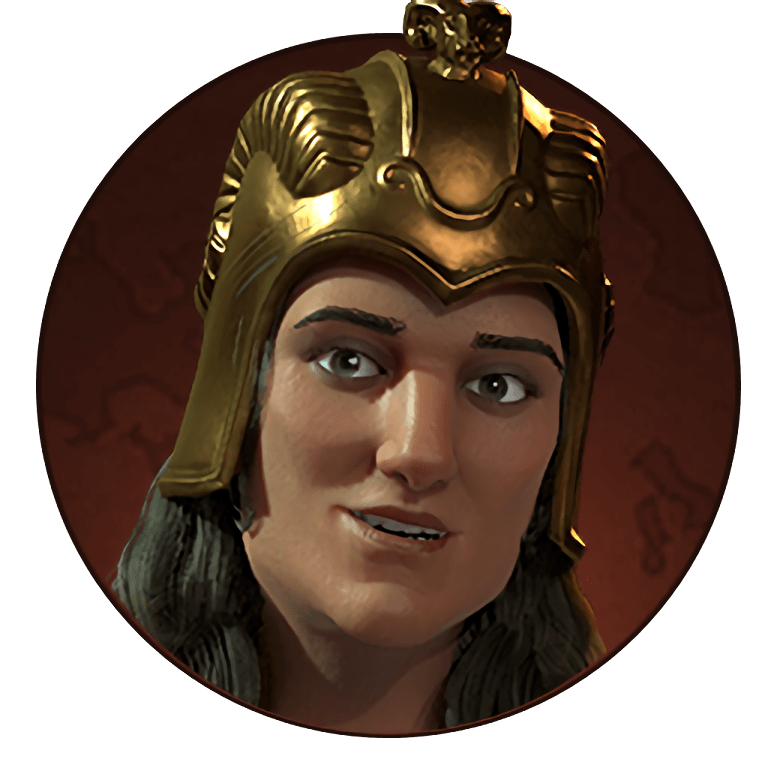
Killer of Cyrus
All units receive +5  Combat Strength when attacking wounded units. When they eliminate a unit, they heal up to 30 hit points.
Here’s what Herodotus had to say, heavily paraphrased...
Tomyris was the widow of a Scythian chieftain c. 530 BC who had assumed his leadership of a group of tribes. The chieftainess also had at least one child, the ill-fated (or perhaps just inept) Spargapises, who commanded the first rank of horse-warriors. Meanwhile, Cyrus had taken command in the Achaemenid Empire (too often referred to as the “First Persian Empire”); although he had plans to expand to the south, which would bring him into conflict with powerful Egypt, he had to first secure his eastern borders, where the unpredictable Scythians (of which the Massagetae were a branch) were raising hell.
Cyrus first tried the usual ploy – if you couldn’t avoid trouble, marry it. He dispatched envoys to Tomyris with an offer of wedded bliss. Tomyris, obviously no fool and realizing it was not her that Cyrus courted but her kingdom, replied in the negative. Cyrus, therefore, marched his army to the River Syr Darya; not concealing his hostile intent, Cyrus ordered boats built. No doubt he figured there’s more than one way to skin a horse. Tomyris, in turn, dispatched a message that called for a battle between the two forces (she’d also assembled her host), reading, in part, “leave your useless toil of bridge-making; let us retire three days’ march from the river bank and do you come across with your soldiers; or, if you like better to give us battle on your side, retire yourself an equal distance.” In council, the great king’s advisors recommended having at it on the Persian side.
But Cyrus was convinced that a different plan would prevail. Upon the advice of Croesus the Lydian, Cyrus agreed to meet the Scythians on their side, crossing the river and marching well inland. There a camp would be established, well stocked with wines and spirits, with which the barbarians were unfamiliar. And it would be guarded by a handful, as Cyrus led his army away to the planned battlefield. But, in truth, the army would march a short ways and await the inevitable attack on the camp by the horsemen. Then, after a suitable time had passed for them to be well intoxicated, Cyrus would fall upon them and thus win the day.
And so it fell out. The drunken Massagetae-Scythian rabble, led by Spargapises, were overwhelmed, losing a third of their number in minutes with most of the rest captured, including Tomyris’ son. Upon hearing of the debacle, Tomyris dispatched a herald to announce that, since he had been captured “by trickery not in the battle of strengths,” her son was to be released. Cyrus refused, and now-sober Spargapises committed suicide (although Herodotus doesn’t provide any details on this). The enraged mother gathered her horse-archers and allies, and gave battle. According to the old Greek’s account...
“The following, as I understand, was the manner of it: First, the two armies stood apart and shot their arrows at each other; then, when their quivers were empty, they closed and fought hand-to-hand with lances and daggers; and thus they continued fighting for a length of time, neither choosing to give ground. At length the Scythians prevailed. The greater part of the army of the Persians was destroyed and Cyrus himself fell, after reigning nine and twenty years. Search was made among the slain by order of the queen for the body of Cyrus. When it was found, she dipped the head of Cyrus into blood and thus insulted the corpse, ‘I live and have conquered you in fight, and yet by you am I ruined, for you took my son with guile; but thus I make good my threat, and give you your fill of blood.’ Of the many different accounts which are given of the death of Cyrus, this which I have followed appears to me most worthy of credit.”
And, with that, Tomyris, warrior-chieftain of the Scythians, disappears from "history" (if she was ever part of it)... as the Scythians themselves would do a few centuries later. But it does make for a rousing tale of a mother’s vengeance.

Preferences
Preferences
Killer of Cyrus
All units receive +5 Combat Strength when attacking wounded units. When they eliminate a unit, they heal up to 30 hit points.
Here’s what Herodotus had to say, heavily paraphrased...
Tomyris was the widow of a Scythian chieftain c. 530 BC who had assumed his leadership of a group of tribes. The chieftainess also had at least one child, the ill-fated (or perhaps just inept) Spargapises, who commanded the first rank of horse-warriors. Meanwhile, Cyrus had taken command in the Achaemenid Empire (too often referred to as the “First Persian Empire”); although he had plans to expand to the south, which would bring him into conflict with powerful Egypt, he had to first secure his eastern borders, where the unpredictable Scythians (of which the Massagetae were a branch) were raising hell.
Cyrus first tried the usual ploy – if you couldn’t avoid trouble, marry it. He dispatched envoys to Tomyris with an offer of wedded bliss. Tomyris, obviously no fool and realizing it was not her that Cyrus courted but her kingdom, replied in the negative. Cyrus, therefore, marched his army to the River Syr Darya; not concealing his hostile intent, Cyrus ordered boats built. No doubt he figured there’s more than one way to skin a horse. Tomyris, in turn, dispatched a message that called for a battle between the two forces (she’d also assembled her host), reading, in part, “leave your useless toil of bridge-making; let us retire three days’ march from the river bank and do you come across with your soldiers; or, if you like better to give us battle on your side, retire yourself an equal distance.” In council, the great king’s advisors recommended having at it on the Persian side.
But Cyrus was convinced that a different plan would prevail. Upon the advice of Croesus the Lydian, Cyrus agreed to meet the Scythians on their side, crossing the river and marching well inland. There a camp would be established, well stocked with wines and spirits, with which the barbarians were unfamiliar. And it would be guarded by a handful, as Cyrus led his army away to the planned battlefield. But, in truth, the army would march a short ways and await the inevitable attack on the camp by the horsemen. Then, after a suitable time had passed for them to be well intoxicated, Cyrus would fall upon them and thus win the day.
And so it fell out. The drunken Massagetae-Scythian rabble, led by Spargapises, were overwhelmed, losing a third of their number in minutes with most of the rest captured, including Tomyris’ son. Upon hearing of the debacle, Tomyris dispatched a herald to announce that, since he had been captured “by trickery not in the battle of strengths,” her son was to be released. Cyrus refused, and now-sober Spargapises committed suicide (although Herodotus doesn’t provide any details on this). The enraged mother gathered her horse-archers and allies, and gave battle. According to the old Greek’s account...
“The following, as I understand, was the manner of it: First, the two armies stood apart and shot their arrows at each other; then, when their quivers were empty, they closed and fought hand-to-hand with lances and daggers; and thus they continued fighting for a length of time, neither choosing to give ground. At length the Scythians prevailed. The greater part of the army of the Persians was destroyed and Cyrus himself fell, after reigning nine and twenty years. Search was made among the slain by order of the queen for the body of Cyrus. When it was found, she dipped the head of Cyrus into blood and thus insulted the corpse, ‘I live and have conquered you in fight, and yet by you am I ruined, for you took my son with guile; but thus I make good my threat, and give you your fill of blood.’ Of the many different accounts which are given of the death of Cyrus, this which I have followed appears to me most worthy of credit.”
And, with that, Tomyris, warrior-chieftain of the Scythians, disappears from "history" (if she was ever part of it)... as the Scythians themselves would do a few centuries later. But it does make for a rousing tale of a mother’s vengeance.