

Civilizations
Leaders
Introduction
Abraham Lincoln
Alexander
Amanitore
Ambiorix
Basil II
Bà Triệu
Catherine de Medici (Black Queen)
Catherine de Medici (Magnificence)
Chandragupta
Cleopatra (Egyptian)
Cleopatra (Ptolemaic)
Cyrus
Dido
Eleanor of Aquitaine (England)
Eleanor of Aquitaine (France)
Elizabeth I
Frederick Barbarossa
Gandhi
Genghis Khan
Gilgamesh
Gitarja
Gorgo
Hammurabi
Harald Hardrada (Konge)
Harald Hardrada (Varangian)
Hojo Tokimune
Jadwiga
Jayavarman VII
João III
John Curtin
Julius Caesar
Kristina
Kublai Khan (China)
Kublai Khan (Mongolia)
Kupe
Lady Six Sky
Lautaro
Ludwig II
Mansa Musa
Matthias Corvinus
Menelik II
Montezuma
Mvemba a Nzinga
Nader Shah
Nzinga Mbande
Pachacuti
Pedro II
Pericles
Peter
Philip II
Poundmaker
Qin (Mandate of Heaven)
Qin (Unifier)
Ramses II
Robert the Bruce
Saladin (Sultan)
Saladin (Vizier)
Sejong
Seondeok
Shaka
Simón Bolívar
Suleiman (Kanuni)
Suleiman (Muhteşem)
Sundiata Keita
Tamar
Teddy Roosevelt (Bull Moose)
Teddy Roosevelt (Rough Rider)
Theodora
Tokugawa
Tomyris
Trajan
Victoria (Age of Empire)
Victoria (Age of Steam)
Wilfrid Laurier
Wilhelmina
Wu Zetian
Yongle


Qhapaq Ñan
Domestic  Trade Routes gain +1
  Food for every Mountain tile in the origin city. Gain the Qhapaq Ñan improvement when Foreign Trade civic is discovered.
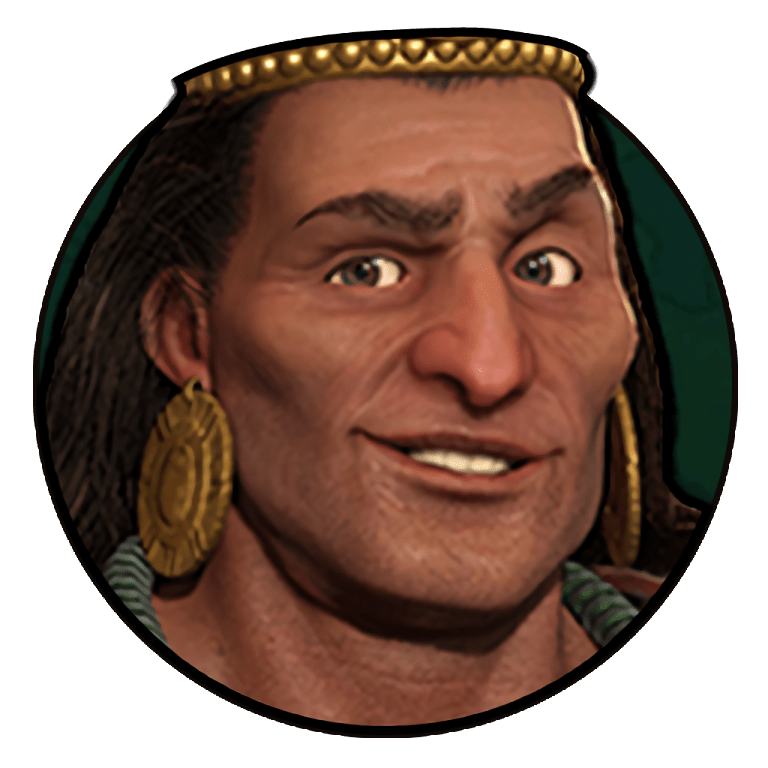
By tradition, he is numbered the ninth ruler of Cusco. Born Cusi Yupanqi, a younger son of Inca Viracocha, he was not in line to inherit the throne. At one point, the neighboring Chanka tribe invaded Cusco, and Viracocha and his chosen heir fled, while Cusi Yupanqi remained behind to organize the successful defense of Cusco. The legend is that “the very stones rose up to defend Cusco,” leading to Pachacuti's new name, which means “earth-shaker” in Quechua.
This victory had the salutary effect of raising his esteem in the eyes of the population and securing himself the chieftaincy upon Viracocha's death. Pachacuti immediately embarked on a campaign of expansion and conquest. Potential subjects were offered an opportunity to incorporate peacefully into the empire, and enjoy the benefits of social organization and material riches. If they accepted, their rulers were brought to Cusco and instructed in Inca governance, or married into Pachacuti's family. If they rejected the overtures, they were subdued militarily.
During Pachacuti's reign, Cusco was expanded as a royal capital befitting an emperor. The Incan religion, centered on the sun god, Inti, was expanded, and the role of the priesthood was further codified within the Empire. Pachacuti himself is credited with composing a number of hymns to the Inca pantheon, which were later recorded by Spanish writers during the colonial period. He may also have established the Inti Raymi holiday, celebrating the start of the new year in the Andes. Pachacuti was a prolific builder. He directed the construction of the massive royal estate at Machu Picchu, as well as irrigation projects, terrace farms, and systems of roads and travelers' hostels.
When Pachacuti died in 1471, power transferred peacefully to his son, Tupac Inca Yupanqi, who had served as either co-regent or battlefield commander during his father's reign. Future Sapa Inca were unable to leave uncontested successions, further burnishing Pachacuti's reputation.
During his lifetime, Pachacuti established the basic pattern of Inca rule: Strong but competent central authority, a highly organized population, and use of the mit'a system of labor in support of public works. But he was also willing to displace large numbers of lower-class people in order to serve his wishes for the empire, and the Inca were willing to engage in war to expand their holdings. Still, he began a remarkable life with no expectation that he would rule, and when he died, the Inca were on the march to become one of the largest civilizations of the New World.


Preferences
Preferences
Qhapaq Ñan
Domestic Trade Routes gain +1 Food for every Mountain tile in the origin city. Gain the Qhapaq Ñan improvement when Foreign Trade civic is discovered.
By tradition, he is numbered the ninth ruler of Cusco. Born Cusi Yupanqi, a younger son of Inca Viracocha, he was not in line to inherit the throne. At one point, the neighboring Chanka tribe invaded Cusco, and Viracocha and his chosen heir fled, while Cusi Yupanqi remained behind to organize the successful defense of Cusco. The legend is that “the very stones rose up to defend Cusco,” leading to Pachacuti's new name, which means “earth-shaker” in Quechua.
This victory had the salutary effect of raising his esteem in the eyes of the population and securing himself the chieftaincy upon Viracocha's death. Pachacuti immediately embarked on a campaign of expansion and conquest. Potential subjects were offered an opportunity to incorporate peacefully into the empire, and enjoy the benefits of social organization and material riches. If they accepted, their rulers were brought to Cusco and instructed in Inca governance, or married into Pachacuti's family. If they rejected the overtures, they were subdued militarily.
During Pachacuti's reign, Cusco was expanded as a royal capital befitting an emperor. The Incan religion, centered on the sun god, Inti, was expanded, and the role of the priesthood was further codified within the Empire. Pachacuti himself is credited with composing a number of hymns to the Inca pantheon, which were later recorded by Spanish writers during the colonial period. He may also have established the Inti Raymi holiday, celebrating the start of the new year in the Andes. Pachacuti was a prolific builder. He directed the construction of the massive royal estate at Machu Picchu, as well as irrigation projects, terrace farms, and systems of roads and travelers' hostels.
When Pachacuti died in 1471, power transferred peacefully to his son, Tupac Inca Yupanqi, who had served as either co-regent or battlefield commander during his father's reign. Future Sapa Inca were unable to leave uncontested successions, further burnishing Pachacuti's reputation.
During his lifetime, Pachacuti established the basic pattern of Inca rule: Strong but competent central authority, a highly organized population, and use of the mit'a system of labor in support of public works. But he was also willing to displace large numbers of lower-class people in order to serve his wishes for the empire, and the Inca were willing to engage in war to expand their holdings. Still, he began a remarkable life with no expectation that he would rule, and when he died, the Inca were on the march to become one of the largest civilizations of the New World.